

MEDIA CENTER
Jan 10th, 2026
Design of Lighting Perforations in Roller Shutter Profiles: The Impact of Hole Shape, Quantity, and Angle on Ventilation Rate
Discover how lighting perforation design in roller shutter profiles influences ventilation rates. This technical guide analyzes the critical roles of hole shape, quantity, and inclination angle in optimizing airflow for aluminum roller shutters, providing expert insights for architectural efficiency and indoor climate control.
Perforation Design in Roller Shutter Profiles: Decisive Factors for Airflow and Ventilation Efficiency
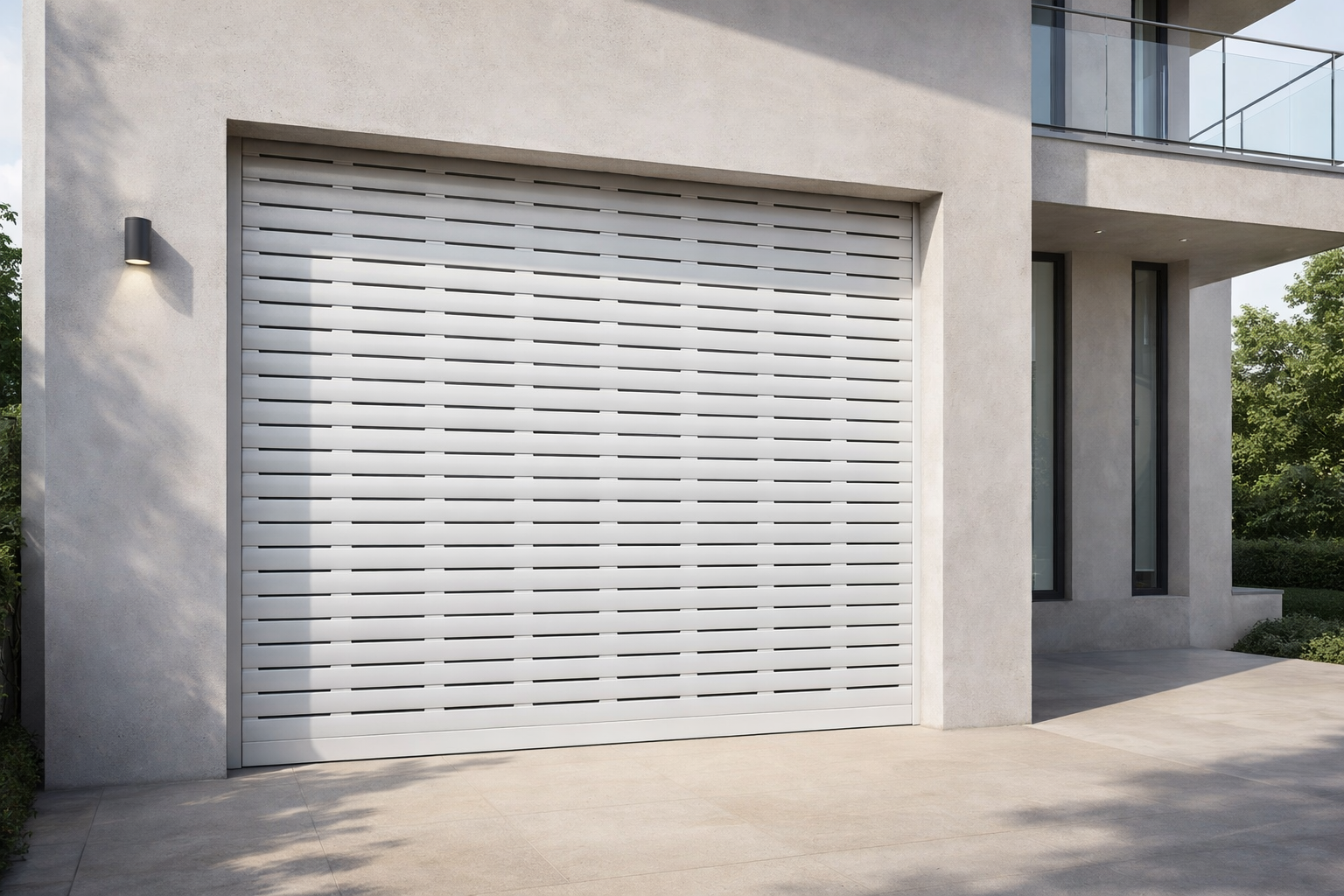
Roller shutter systems, particularly those utilizing extruded aluminum profiles, are indispensable in modern architecture. Beyond their core functions of security and privacy, they integrate lighting perforations (or ventilation slots) to facilitate natural airflow and day-lighting.
However, these micro-perforations are not merely aesthetic. The shape, quantity, and angle of the holes are critical variables that dictate the ventilation rate and fluid dynamics of the system. Understanding the relationship between these design parameters and aerodynamic performance is essential for manufacturing high-performance, comfort-oriented roller shutter products.
Industry Context and Design Challenges: Why Ventilation Matters
1. Sector Applications
Roller shutter profiles are widely utilized across various sectors:
Residential (Windows/Balconies): Requiring a balance between solar shading, thermal insulation, security, and nocturnal natural ventilation.
Commercial & Industrial (High-Speed Doors, Garages): Essential for maintaining air circulation in work zones, especially in logistics, food processing, and warehousing.
2. The Design Paradox: Balancing Airflow with Structural Integrity
Increasing the ventilation rate often involves a trade-off with material integrity and security. An optimized design must achieve equilibrium between:
Maximizing Volumetric Flow Rate
Maintaining Profile Rigidity (Wind Load Resistance)
Ensuring Anti-insect and Burglary Protection
Meeting Acoustic and Thermal Insulation standards
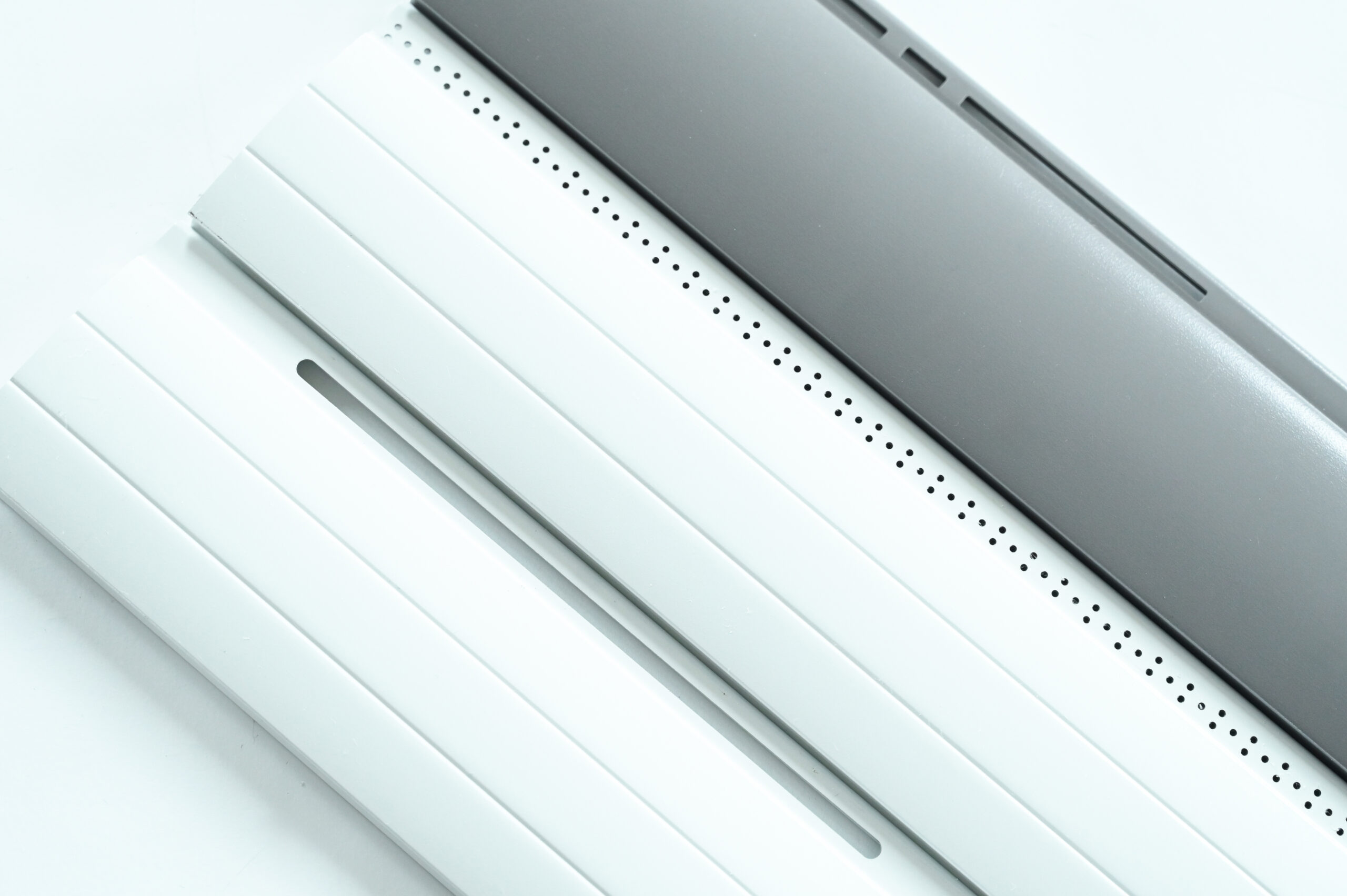
Core Factor I: Influence of Hole Shape on Ventilation Efficiency
The geometry of the perforation is the primary determinant of airflow patterns and pressure drops.
Shape | Aerodynamic Characteristics | Advantages | Disadvantages |
Circular | Stable airflow, minimal resistance. | Ease of manufacturing; retains structural strength. | Lower ventilation area per unit. |
Rectangular | Prone to vortex formation; higher drag. | Flexible design; facilitates louver-style shading. | Stress concentration at corners may reduce profile lifespan. |
Louvered (Slotted) | Directional airflow (upward or downward). | Simultaneous ventilation, rain protection, and shading. | Complex tooling; higher production costs. |
Key Insight: The Louvered Design
In high-performance shutter profiles, the Louvered (or punched slot) design is the industry standard. By utilizing an inclined edge to guide air, it significantly increases the ventilation rate while maintaining visual opacity and weather resistance.
Core Factor II: Optimizing Hole Quantity and Open Area Ratio
The quantity of holes directly determines the Open Area Ratio (OAR) of the profile.
OAR =(Total Area of Perforations / Total Surface Area of the Profile)*100%
1. Correlation Between Ventilation and OAR
The ventilation rate is non-linearly correlated with the OAR. Excessive perforation does not always yield proportional benefits.
Low OAR (< 5%): Airflow is negligible; fails to improve indoor air quality.
High OAR (> 40%): Drastic reduction in mechanical strength, failing to meet wind load safety codes.
2. Distribution and Density
Given a fixed total open area, a higher density of smaller perforations is generally superior to a few large openings.
Benefit: Uniform distribution creates a stable micro-airflow and reduces localized stress concentrations, enhancing both the security profile and the ability to block insects.
Core Factor III: Impact of Hole Angle on Airflow Guidance and Drag
The inclination angle (specifically in louvered designs) is the key to directional ventilation and minimizing aerodynamic resistance.
1. Directional Airflow Guidance
0° (Vertical/Horizontal): Maximum raw airflow but lacks directionality and rain protection.
Inclination Angle ($\theta$): Typically engineered between15°and 45°.
Function: Even when the shutter is closed, the angle directs air while acting as a barrier against rainwater.
Effect: Maintains ventilation capacity during inclement weather or high-wind scenarios.
2. Drag Coefficient
The angle affects the Drag Coefficient of the profile.
A lower Drag Coefficient allows a higher volume of air to pass through at the same wind pressure.
CFD (Computational Fluid Dynamics) simulations indicate that optimized angles minimize flow separation and vortex shedding, thereby reducing resistance and boosting the effective ventilation rate.
Optimization Strategy: Integrating CFD with Industry Standards
High-quality roller shutter design requires a synergy between fluid dynamics and compliance.
Preferred Geometry: Utilize optimized louvered slots for a multi-functional approach (ventilation + shading + drainage).
OAR Threshold: Aim for a “Golden Zone” of 10% – 20% Open Area Ratio to balance airflow with structural safety.
Angular Precision: Use CFD modeling to refine the inclination, generally recommending a range of 20° to 30° for optimal results.
Material Integrity: Specify high-grade 6063-T5 aluminum with anodic oxidation or powder coating to compensate for the reduction in cross-sectional area.
Conclusion: Achieving the Synergy of Ventilation and Performance
The design of perforations in roller shutter profiles is a sophisticated engineering task. By precisely calibrating the shape, quantity, and angle of these openings, manufacturers can significantly enhance the ventilation rate without compromising structural durability or security. This creates a superior product that offers energy efficiency and enhanced living comfort for the end-user.
Contact us

Grace
Account Manager

info@ulepanda.com

+86 15836962895

+86 15836962895